
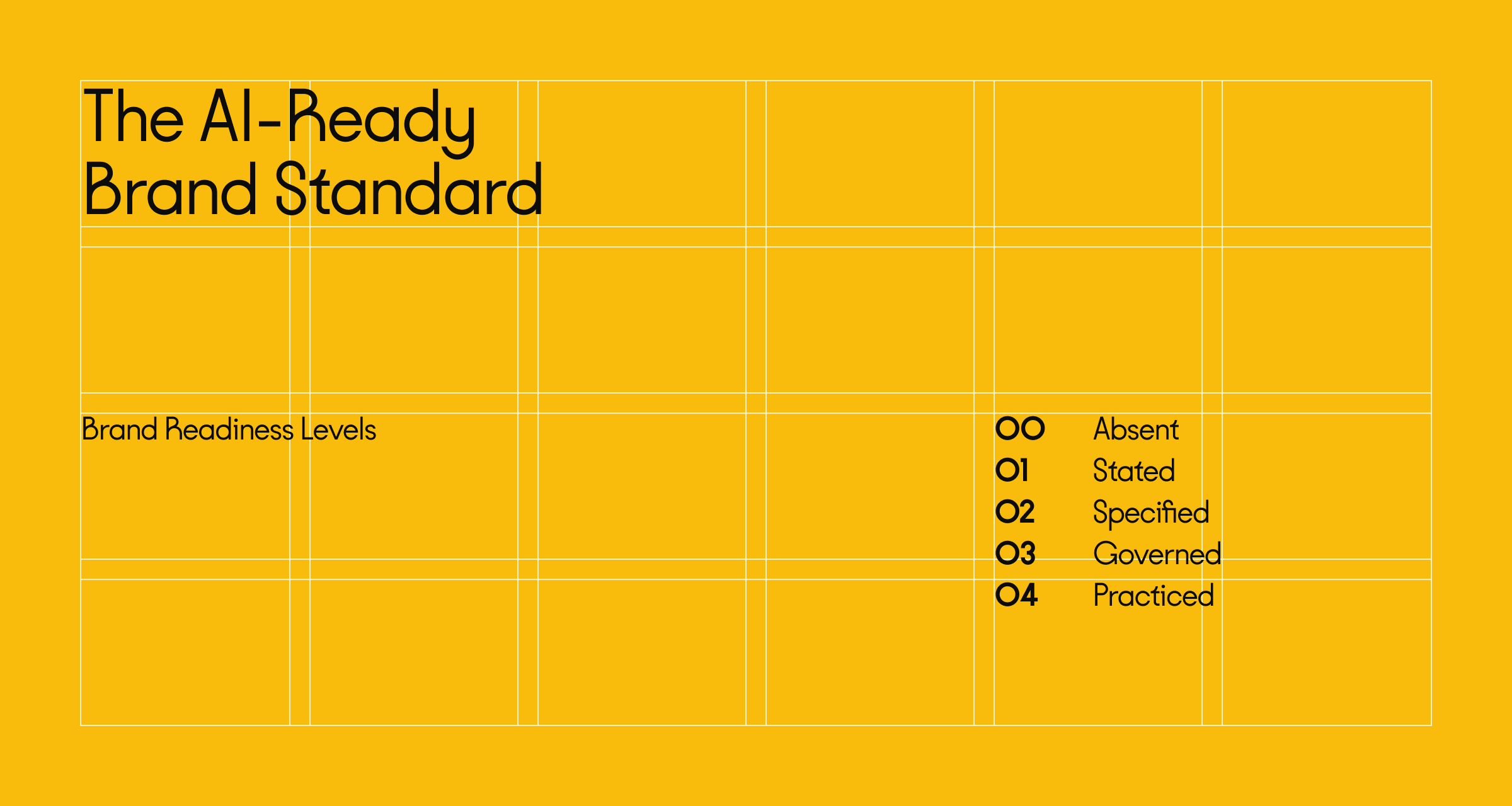
What AI-ready actually means for a brand and how to measure it.
Thoughts included:
- Why a checklist cannot answer the question
- Two tests
- The five levels
- Where the work actually is
- Why Level 4 requires proof
- The twelve brand dimensions
- How to score it
- What this does not measure
Brand guidelines have one job: keep the brand intact after we deliver it.
For years, we wrote them for designers. A good designer could read "confident but never arrogant," study the work around it, and tell the difference between right and almost right.
But now, AI is the one doing the "reading." They pass through tools that do not know why specific choices were made. The person prompting the tool may not be a designer either. When the guidelines leave room to guess, AI fills that room with the most average answer available. Meaning that when a brand is written clearly, more people can use it without watering it down. And when not, the brand drifts with every unchecked output. I wrote about how we got here earlier this year.
That shift changed the question we ask at handoff:
What does AI need in order to use this brand correctly?
Why a checklist cannot answer the question
The obvious answer was a checklist. We built one around the usual sections: strategy, voice, logo, color, type, imagery, and layout.
Spoiler... it didn’t work.
Two brands could check every box and still produce completely different work once AI touched them. The checklist told us what was there. It could not tell us whether the sections contained instructions AI could use. When those instructions were missing, AI did not flag the gap. It made the work anyway, often competently enough to ship.
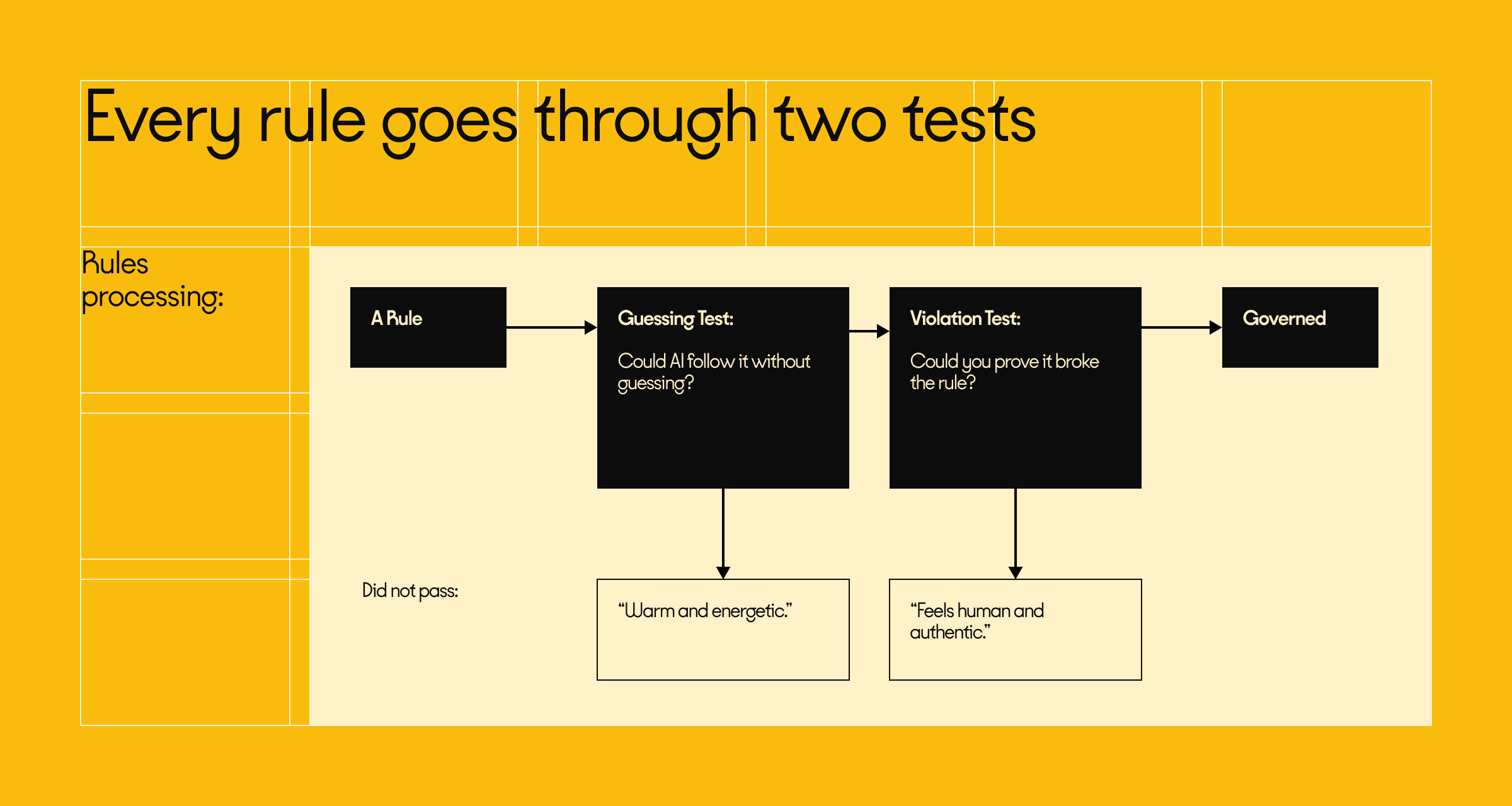
So we stopped scoring sections and started scoring the instructions inside them. A description tells AI what the brand feels like. An instruction tells it what choice to make. From then on, every rule had to pass two tests.
Two tests
We run every rule in a brand system against two tests.
The guessing test. Could AI follow this rule without guessing?
- "Our palette is warm and energetic" fails.
- "The accent covers about 10% of any layout and never sits behind text" passes.
The violation test. Could you point at a finished piece of work and prove it broke the rule?
- "Our photography feels human and authentic" fails. Nothing can break it, so nothing can follow it.
- "The accent never sits behind text" passes. Any text on the accent proves the breach.
If a rule fails either test, you do not have a rule. You have a mood.
Most guidelines fail both. They were written for someone who would be in the room and soak up the ambiguity.
The five levels
When we scored client systems and our own, we noticed a pattern: every part of a brand landed at one of five levels. We call them Brand Readiness Levels.
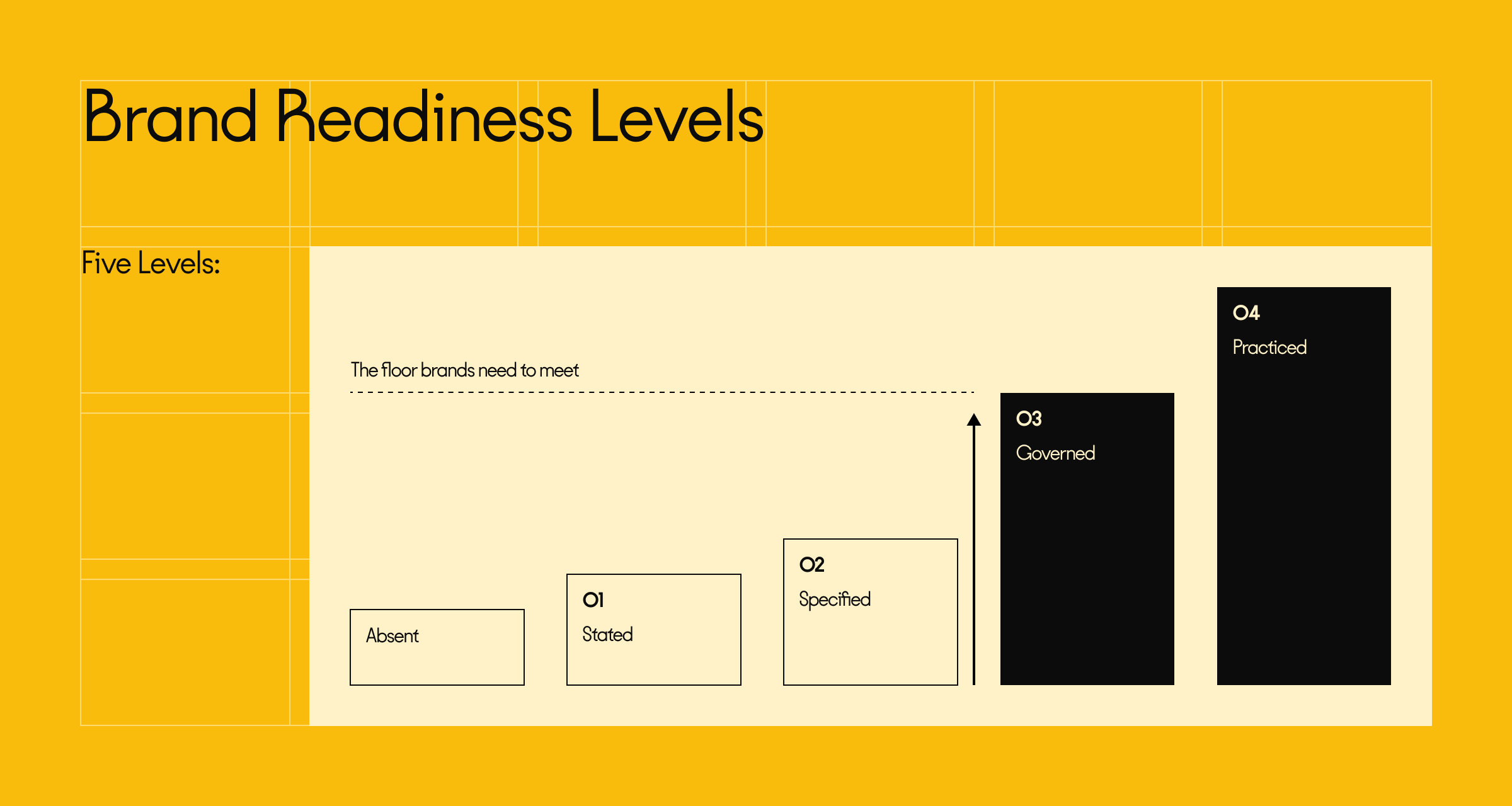
Level 0, Absent
"No color section."
It happens more often than you would think once you look past the logo pages.
Level 1, Stated
"The color palette is warm and confident, with a bold accent."
A person forms an impression. AI has nothing to act on.
Level 2, Specified
"Blue #1B3A5C. Signal Orange #E8622A. Paper #F8F7F4."
The values and names are exact, but there is no instruction for how to use them.
Level 3, Governed
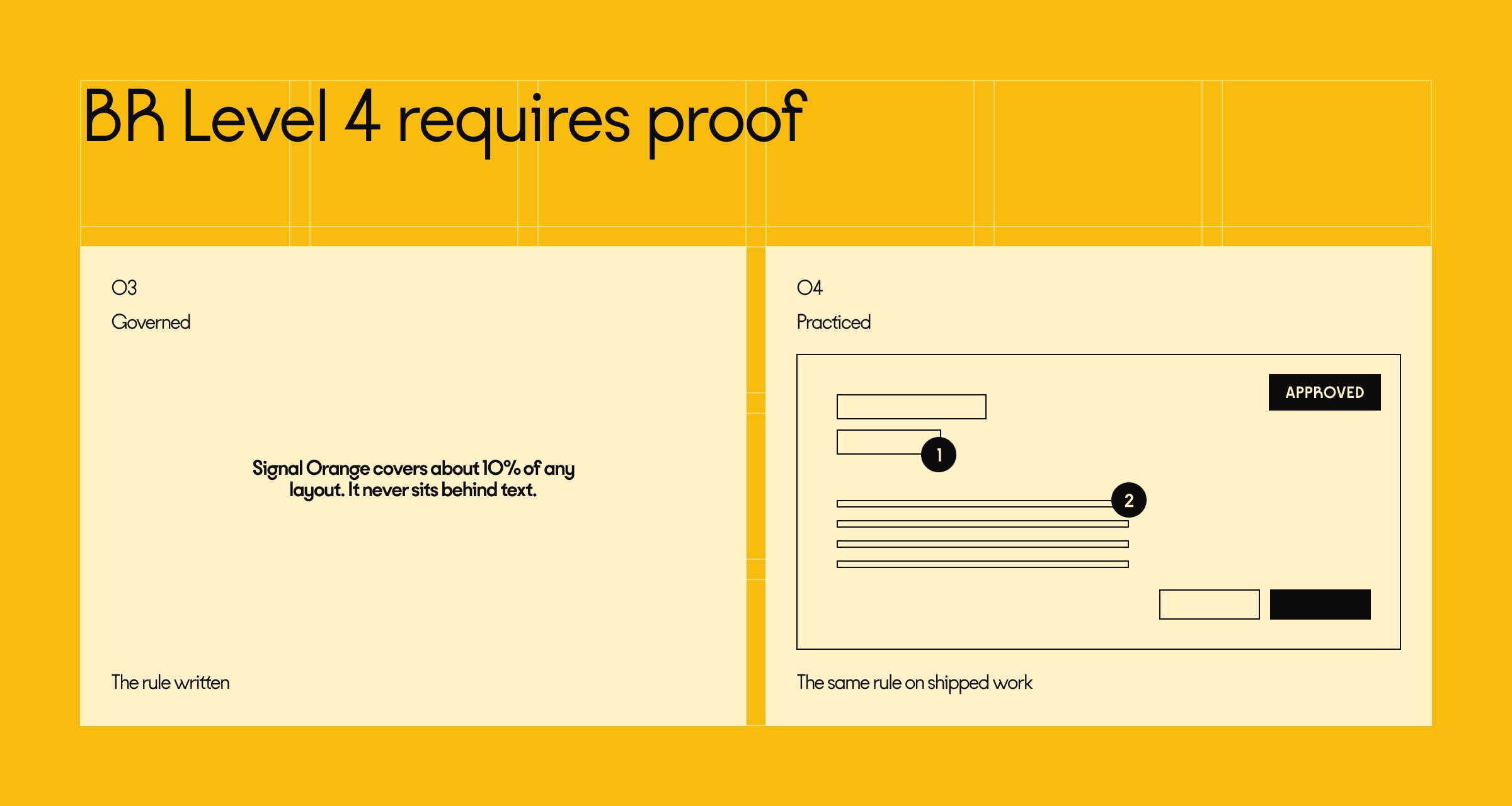
"Signal Orange is for interactive elements. It covers roughly 10% of any layout. It never sits behind text or fills an entire background. On Paper, it clears 4.5:1."
Now AI can act, and you can prove when it got the rule wrong. This is the floor.
Level 4, Practiced
"Level 3, plus an approved layout with the rules marked on it, showing the 10% in use and why the accent sits where it does."
Real work that already shipped, with the decisions attached.
Where the work actually is
Most of what I see sits at Level 2. The values are exact. The instructions are missing.
That can still be excellent work. It may be beautifully made and useful to the people it was built for. Until recently, a good brand book did not need every decision spelled out. The designers using it already knew how to fill in the gaps.
Getting from Brand Readiness Level 2 to Level 3 is mostly a writing problem. You take the decisions your design team already makes without thinking and put them into words AI can act on. Very little of it is new. It is existing thinking made visible.
The work is smaller than it sounds. We sit down with the people who know the brand best and pull up work that feels slightly off: the deck a partner made or the banner from the regional team. We ask what isn't working and listen for sentences that begin with "we would never."
"We would never put the accent behind a headline. We would never crop a portrait at the chin."
Those are Level 3 rules. The team has carried them unwritten for years. Our job is to notice the rule and put it somewhere the next person, or the next tool, can find it.
Then we put each sentence through the two tests. "We would never make it feel corporate" fails both and goes in the bin. "We would never set body copy below 16px" passes both and goes in the guidelines.
We learned two other things while scoring real systems and applying the same work to our own tool, TrueKeep:
- Rules must include specific context. A rule rarely arrives with the paragraph that introduced it. A tool retrieves it, or someone skims straight to it, and it lands on its own. "Use it sparingly" means nothing by itself. "Use the accent sparingly" leaves no room for AI tools.
- Make it retrievable. In one brand guide, clear space and minimum sizes appeared twice: inside a diagram and in the paragraph beside it. A tool had to find the right number and connect it to the right rule. Give each number its own label and cell. Retrieval becomes more reliable, and a person can check it faster too.
Why Level 4 requires proof
You can write a brand up to Level 3. Level 4 needs evidence.
Practiced means real work already approved by the people who own the brand, with the decisions marked on it. A polished brand system can be written to a template. Shipped work shows whether the team actually uses it.
Level 4 should be selective. Marked-up references everywhere would make the guidelines harder to use. Surfaces that the agent is most likely to generate are the most useful to have specific examples. A binary rule does not need one.
Governed (3) is enough
- Editorial style
- Logo
- Color
- Typography
- Actions and interactive
Needs Practiced (4)
- Brand in context (mandatory)
- Layout and composition
- Voice and tone
- Photography and imagery
The twelve brand dimensions
These twelve dimensions make up the core of brand guidelines. A completeness check asks whether each section is present. The table compares that with what the section needs to say before AI can follow it without guessing.
For each dimension, "Present" is what a completeness check accepts and "Followable" is what AI needs to act.
Identity and strategy
- Present: Belief, promise, and audiences included
- Followable: Promise and belief written in language someone can use. Audiences ranked. Positioning clear enough to rule something out.
Brand signals
- Present: Attributes listed
- Followable: Each attribute tied to a visible choice. "Rigorous" becomes "structured, grid-based layout."
Voice and tone
- Present: Tone described
- Followable: Do and don't pairs, banned words, a before-and-after rewrite, and rules for when the voice gets louder or quieter.
Editorial style
- Present: Style notes included
- Followable: Casing, dashes, numbers, and punctuation decided. The tool should not make a new choice every time.
Logo
- Present: Files uploaded
- Followable: Rules for which variant to use, where it sits, how small it can go, what backgrounds it can sit on, and what never to do with it.
Color
- Present: Palette with hex values
- Followable: A role for each color, distribution percentages, allowed pairings, contrast floors, and clear limits.
Typography
- Present: Font families named
- Followable: Weights matched to the licensed files. A role for each tier. A size scale that preserves the hierarchy in any medium. Casing and tracking decided.
Photography and imagery
- Present: Examples uploaded
- Followable: Treatment written as checkable rules. The examples are described as well as shown.
Layout and composition
- Present: Grid mentioned
- Followable: Anchor rules, spacing logic, column limits, and a clear position on whitespace, with numbers where they matter.
Brand in context
- Present: Example images included
- Followable: Notes on real work written as rules. "Content starts top left. The logo aligns with the first text baseline." At least one medium shown from start to finish.
Actions and interactive
- Present: Buttons shown
- Followable: Exact treatment for each medium, with rules for what can change and what cannot.
Anti-patterns
- Present: Scattered don'ts
- Followable: Each don't attached to the part of the system it belongs to, then collected in one place. A system with no don'ts leaves AI free to improvise.
How to score it
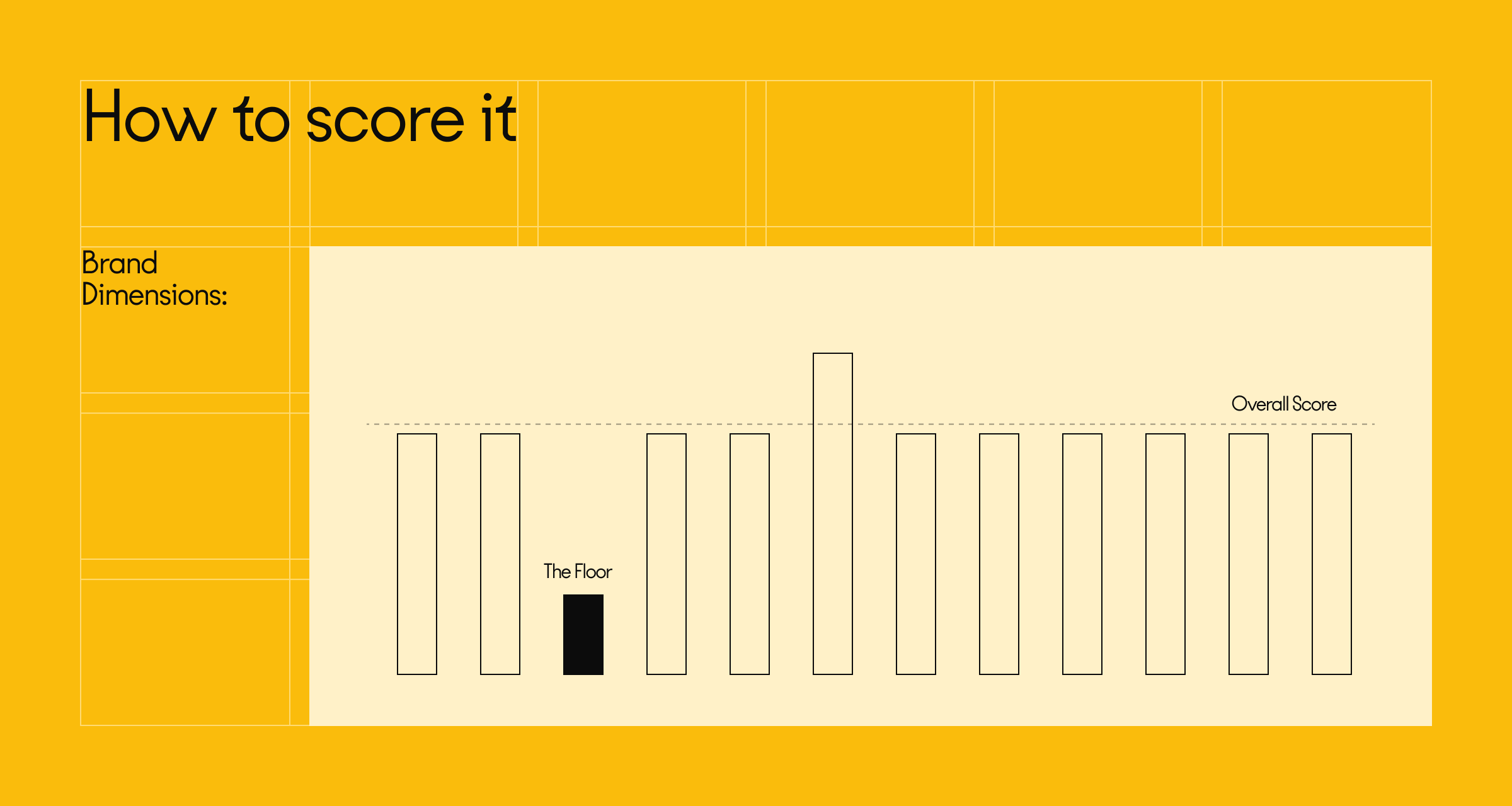
Keep one distinction in mind:
Ten dimensions calculate the overall score. All twelve determine the floor and tier.
1. Start with each dimension
Score each of the twelve dimensions from 0 to 4.
Each point represents one quarter of the scale:
0 = 0% · 1 = 25% · 2 = 50% · 3 = 75% · 4 = 100%
The first goal is simple: get every core dimension to Level 3. Then reach Level 4 where real examples matter, especially brand in context and at least voice or layout.
Your lowest dimension score is the floor. There is no calculation. If voice is at Level 1 and everything else is at Level 3, the floor is 1. Fix that first. A brand usually drifts at its weakest point while everything around it still looks right.
2. Calculate the overall score
Once every dimension has a score, calculate the overall score.
This is where the math happens.
The dimensions do not count equally. We set the weights using two things: how often a dimension drifts and how hard that drift is for a tool to catch.
Weighting principle: drift risk ÷ machine enforceability
Voice can drift in almost every line of copy, and a person still has to judge it. That gives it the highest weight. A logo needs fewer rules, and its worst failure can be caught automatically. That gives it the lowest weight.
- 15% each: Voice and tone, color, layout and composition, brand in context
- 10% each: Identity and strategy, typography
- 5% each: Brand signals, logo, photography and imagery, actions and interactive
Multiply each dimension's score by its weight, then add the results.
Overall score = the sum of each dimension's score × its weight
A voice score of 3 carries 15% of the total, so it contributes 0.45 points:
3 × 0.15 = 0.45
The weights add up to 100%, so the final result stays on the 0-to-4 scale. An overall score of 2.8 is the same as 70%.
Note: Editorial style and anti-patterns are still scored, but they do not receive a separate weight because they already affect the other ten dimensions. They can still become the floor.
3. Determine the tier
The overall score shows how the system is doing as a whole. The individual dimension scores determine which tier it reaches. A strong average cannot cancel a weak floor.
- Stated. Most of the brand is described, but the instructions stop at Level 1. A brand book written for people. The PDF without the design intent.
- Specified. The values exist, but the rules for using them are mostly missing. Most of the system stops at Level 2.
- Governed. Most core dimensions are at Level 3, with none below Level 2.
- AI-ready. Every core dimension reaches Level 3 or above. Brand in context reaches Level 4, along with either voice or layout.
What this does not measure
It does not tell you whether your brand is any good.
It measures whether a tool with no history can reproduce the brand faithfully. If your strategy says nothing, AI can now repeat that nothing very cleanly.
It will not tell you the accent should be orange or which audience the whole brand should serve. Those are brand decisions. They take taste and a reason you can defend. It protects those choices after you make them.