
Generally in startups, digital products, and business, there is little focus on being creative as an individual. Instead, the focus is primarily on becoming more productive as individuals, and being more innovative as an organization.
As the world moves further away from purely execution work, creativity is going to become more of a core skill to have, and likely one of the biggest differentiators in talent.
I believe the theories, and history, of organizational creativity that powered creative giants like Bell Labs, Xerox PARC, and 3M have lessons that lay the framework for individuals who want to mirror this innovation in their own work.
Safi Bahcall's Loonshots is a great book on how those organizations functioned. One of his main ideas is of Dynamic Equilibrium. This happens when the "franchise" side of an organization (the steady, profitable, predictable work) and the "loonshot" side (the fragile, easily dismissed ideas) are kept separate and given equal footing. He talks about how this is a requirement for the biggest breakthroughs. Bahcall is mostly writing about organizations, and how to structure them so a sustaining business and a world-changing idea can live under the same roof.
AI as the Franchise
He mentions, almost in passing, that an individual can play both roles depending on the phase of the work. That line stuck with me, because I think it's about to matter for everyone.
For most of history, an individual hasn’t had the luxury of a franchise department. If you wanted to build something, you had to do the building yourself, which meant most of your time and energy went to execution. AI has the potential to change that. If we treat AI as our franchise, the part that executes the profitable but non-novel work, then we're free to spend our own attention on the loonshots. The breakthroughs that used to require a Bell Labs are starting to come within reach of a single person with the right habits.
The problem for many digital builders and leaders is that we have spent our careers training the opposite muscle.
The Opposite Muscle
I can't think of many times where I've had big breakthrough ideas while also being highly productive in terms of execution work. Usually, 'aha' moments are completely separated from daily work. They come on vacation, in the middle of the night, or at any other time that's least expected. At other times, I've had prolific stretches of coding for days or weeks. At the end, I'm blown away by the output, but very rarely is there anything truly novel that I've built.
I don't think I'm unusual in this. Lin-Manuel Miranda has said the idea for Hamilton came to him on vacation, reading a biography by the pool, far away from his normal routine. He talks about boredom as being key. Charles Darwin built a gravel path behind his house he called the Sandwalk and walked it twice a day to think, kicking flints into a pile to count his laps so he wouldn't have to stop and keep track. Henri Poincaré described the solution to a problem he'd been stuck on for weeks arriving the moment he stepped onto a bus, after he'd given up and set the work aside entirely.
None of them had their best ideas while grinding away.
This isn’t a new observation at all, and more and more people are realizing the benefits of this type of ‘space’. Poincaré, and later the people who studied how he worked, described creative thought in stages: a period of conscious effort, a period of letting go, the flash of insight, and then the work of verifying it. I think the future is going to require us to lean into this method even harder.
A Framework: Frontiers and Foundations
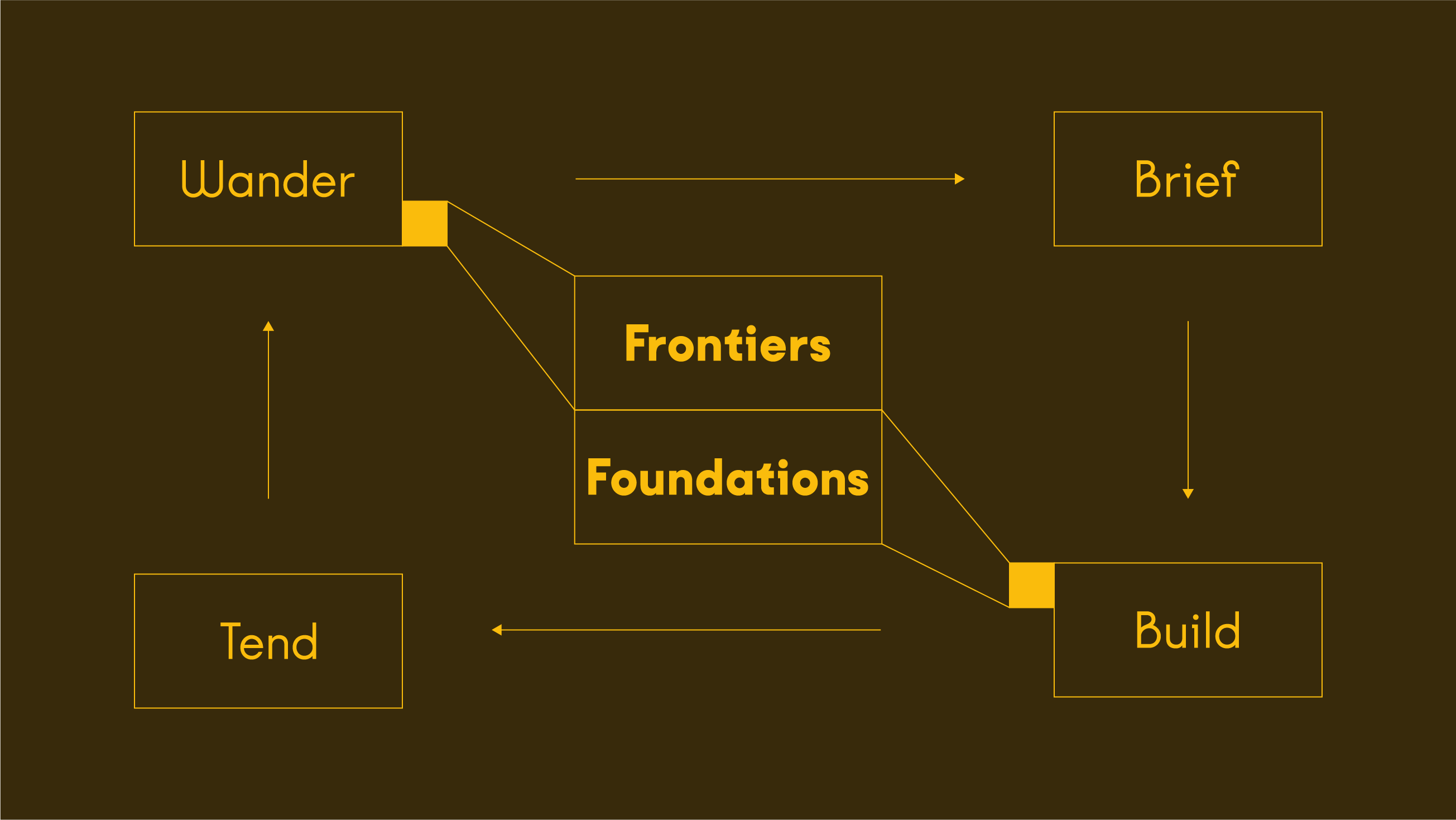
To help get myself to this place I've tried to organize my own work into four phases across two modes I call Frontiers and Foundations.
In Frontiers, we explore ideas and problems. Foundations is where they’re built and maintained.
Frontiers
- Wander - The key to innovation or disruptive ideas is developing the ‘wander’ muscle. This means gathering inspiration and finding quiet where new ideas can surface. I think this happens best away from screens. If you’re able to find a dedicated space in the office or at home, this separates this time for your brain. I like to have pencil and paper ready, and I’m not hesitant to take a walk or explore during this time. Ideas here can take a lot of different shapes:
- New ways of solving an existing problem.
- A product breakthrough or what Bahcall calls a P-type loonshot.
- A strategic breakthrough or what Bahcall names a S-type loonshot.
- Brief - Staying in a frontier mindset, now it’s time to create a brief for the execution of the idea. Without getting into the weeds of execution, relay the most important details and outcomes needed to fully execute this idea.
Foundations
- Build - The phase of “Aligned Execution”. AI makes execution much faster, but the key to this phase is review and reinforcement. Your job in this phase isn’t to execute yourself but to review across multiple parallel tracks of work, ensuring the output matches the brief and the quality necessary.
- Tend - This phase is for the logistics and the muddiness of everyday work. It’s the time for meetings, the looping and retrospection of work, and the unguided execution work that is still necessary.
.jpg)